Showing posts with label Houseplant Care. Show all posts

Thursday, November 8, 2018

HOW TO: Croton Plant Care

So, you've just brought home one of these colorful beauties and you want to keep it lush and beautiful. Allow us to help!

Crotons are offered in different types, wide and narrow leaf varieties, even ones with curling leaves. But they all crave the same basic care needs: Bright light (not direct sunlight), proper watering and the right size container. Inside the home, temperatures should be between 60 and 75 degrees Fahrenheit. Temperatures above 80F may cause your croton to wilt, dry out and drop leaves.

Between waterings, allow the soil to dry out. Do not over-water your plant, for it will cause the leaves to yellow (and possibly rot). Slowly add water and allow it to soak into the soil.
Fertilize your plant once a month with a fertilizer low in nitrogen. Back off the fertilizer during Winter. If you place your croton outdoors during Summer months, a dappled sunlight is best (you could "cook" the plant in full sun).  Use a pot with a draining hole and saucer and good potting soil that retains moisture.

Come see the varieties of Crotons we have at Oakdale Greenhouses – ours are specially selected for robust growth inside your home. Visit our website for maps, hours, directions and more information: www.OakdaleGreenhouses.com.

Friday, November 2, 2018

ARTICLE FIND: Guide to Choosing Houseplants

We constantly scour the website in search for informative articles. This one, from Better Homes and Gardens, features ways to select the best houseplants for your home. You'll find these plants and more at Oakdale Greenhouses in Charlotte!

Guide to Choosing Houseplants

Photo Credit: Better Homes and Gardens

Wednesday, October 17, 2018

PLANTS WE LOVE: Ponytail Palm


Ponytail Palms (also known as Elephant's Foot Palms) are a long-lived indoor plant that thrives on neglect. Easy to grow, adaptable to various light conditions and rewarding.

The Ponytail is not a true palm -- it's actually closely related to Dessert plants like Agave or Yucca and is native to eastern Mexico. Bases of the plant are a large, water storing stump which tapers off to a thinner stem. Atop the stem, long green leathery leaves form to create a unique look. As the plant ages, the leaves grow longer and atop the plant more form. With proper care, this plant may grow to become several feet tall over time.

Sometimes you'll find Ponytails with multiple base stumps, shown in our photo. The stumps may be divided into separate plants, or allowed to cluster providing an interesting overall effect.

This is a rather easy to care for plant. It likes a filtered light and will adapt to various locations. Should the end of the "leaves" become brown, a quick trim restores the plant to wonderful glory. Water only when the soil becomes dry, they don't like to be overwatered. You may place them outdoors in a dappled sunlight by gradually acclimating them to the selected environment. Don't leave them out when evening temperatures are lower than 55 degrees. Fertilize them in Spring and mid-summer with a "Cactus" fertilizer mixed with their water.

Use a fast draining soil, such as a cacti and succulent potting mix. Create your own mix with 1 part perlite, one part sand and one part quality potting mix. Select a container with a drainage hole and do not allow the plant to stand in water - clay pots are preferred as they will absorb water and dry the soil out more quickly. Be careful when moving the plant around, as it has serrated edges that may cut skin.

Take home a Ponytail from Oakdale Greenhouses, we have many sizes available! Hours, directions and more are on our webite: www.OakdaleGreenhouses.com

Photo Credit: Raymond Cathode

Monday, September 3, 2018

Got Bugs? This stuff will wipe them out!

I recently discovered mealybugs on my Hoya plant. Grrrrrr. I couldn't understand how they got into my pristine plant environment: I hadn't added anything new in that room for a while yet there they were, sticky white remnants where the leaves met branches.

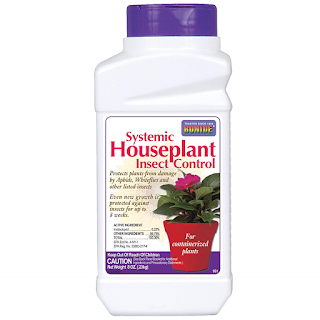
After hosing down the plant in the sink, I immediately ordered a container of "Systemic Houseplant Insect Control" and got to work, adding it in the prescribed amount to all of the plants in the environment. After a few weeks, no more infestation.

Now you don't want to go using a product like this on food you're going to eat, nor do you want pets or kids getting into the stuff. But it works, and works well, eradicating the little buggers by poisoning them from the inside of the plant. "Systemic" insecticides work by introducing itself via the roots and circulating throughout the entire plant, killing off various bugs that dare dine on it.

Highly recommended that you keep an eye on your plants, for apparently infestations can hit you even after a few years of a clean environment.  Here's the product I purchased:

Systemic Houseplant Insect Control
From Amazon.Com